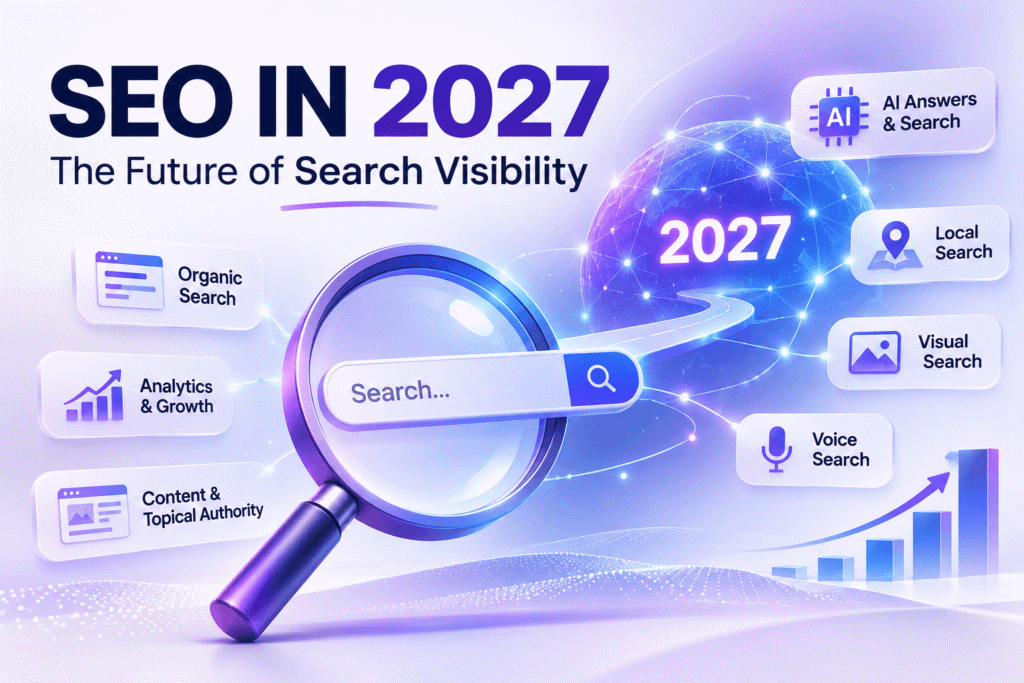

Search engine optimization is entering another important phase. As we approach 2027, the way people search, discover businesses, and make purchasing decisions is changing.
For years, SEO focused primarily on ranking websites on Google. Keywords, backlinks, content optimization, and technical improvements formed the foundation of most SEO strategies.
Those fundamentals still matter. However, the search landscape is expanding.
People now discover information through Google Search, AI Overviews, ChatGPT, Gemini, Perplexity, YouTube, and other platforms. Some searches end with a website visit, while others are answered directly within the search experience.
So, what does this mean for businesses, website owners, and SEO professionals?
SEO in 2027 will be about building visibility, credibility, and conversions across multiple discovery platforms, not simply chasing Google rankings.
Let’s explore what is changing, what remains important, and how businesses should prepare.
1. SEO Will Expand Beyond Traditional Google Rankings
Ranking on Google’s first page has traditionally been a major objective of SEO campaigns.
But a high ranking is no longer the only way customers discover businesses.
Consider how search behavior is changing. A potential customer might research a product using ChatGPT, compare options on Google, watch a YouTube review, and finally visit a company’s website before purchasing.
Each interaction contributes to the customer’s decision.
In 2027, businesses should prepare to measure their visibility across more than one platform.
That does not mean abandoning traditional SEO. Google rankings, organic clicks, and website traffic remain valuable.
Instead, SEO strategies should become more comprehensive, combining conventional organic search with AI search optimization and other relevant discovery channels.
The goal is simple: make your business easy to discover wherever your potential customers are searching.
2. AI Search Optimization Will Become a Bigger Priority
AI-powered search is one of the most significant developments affecting SEO.
Platforms such as ChatGPT, Gemini, and Perplexity can answer questions, summarize information, compare services, and reference external sources.
Google is also integrating AI-generated responses into its search experiences.
This creates a new challenge for website owners.
Your content must remain useful to traditional search engines while also being understandable and credible enough to appear as a source in AI-generated answers.
How should businesses prepare?
Focus on creating content that provides genuine value.
-
Answer important customer questions clearly.
-
Use descriptive headings and logical content structures.
-
Include original examples, observations, and research.
-
Keep important information accurate and updated.
-
Make content accessible to relevant search crawlers.
-
Establish clear information about your business, services, and expertise.
Remember that no SEO technique guarantees citations or recommendations from AI platforms.
The objective is to improve the quality, accessibility, and credibility of your information.
Businesses interested in this area should explore how AEO, GEO, and AI search optimization fit into their existing SEO strategy.
3. Search Intent Will Matter More Than Keyword Frequency
There was a time when SEO content strategies relied heavily on repeating target keywords.
Modern search systems are considerably more sophisticated.
They attempt to understand what users actually want rather than relying exclusively on exact keyword matches.
In 2027, a successful content strategy should reflect different stages of the customer journey.
For example, someone searching for “what is technical SEO” probably wants an explanation.
A person searching for “technical SEO consultant” is more likely to be evaluating professional services.
Although both searches concern technical SEO, they require different types of content.
Businesses should organize their websites around informational, commercial, transactional, and navigational intent.
Effective on-page SEO connects search intent with useful content, clear page structure, internal links, and meaningful calls to action.
The objective is not simply to attract more visitors. It is to attract visitors whose needs your website can genuinely satisfy.
4. Technical SEO Will Remain Essential
With all the excitement surrounding artificial intelligence, businesses should not overlook technical SEO.
Search engines still need to discover, crawl, process, and index website content.
A website with significant technical problems may struggle to establish organic visibility regardless of how helpful its content is.
Important technical SEO priorities for 2027 include:
-
Crawlability and indexability
-
Canonical tags and redirect management
-
XML sitemap accuracy
-
Mobile usability
-
Core Web Vitals and website performance
-
Logical website architecture
-
Internal linking
-
Structured data where appropriate
-
JavaScript rendering and content accessibility
One particularly important consideration is ensuring that relevant content can be accessed and understood without unnecessary technical barriers.
Structured data can help eligible search engines interpret page information, but it does not guarantee enhanced search appearances or AI visibility.
A comprehensive technical SEO audit can identify issues that prevent a website from reaching its full potential.
My prediction: Technical SEO will become even more valuable as businesses try to maintain visibility across increasingly complex search experiences.
5. Brand Authority and Trust Will Become Stronger Competitive Advantages
One of the most important questions businesses should ask is:
Why should a search engine or AI assistant trust our website over another source?
Publishing large amounts of generic content is unlikely to provide a sustainable competitive advantage.
Businesses need to demonstrate credibility through genuine expertise, useful information, and a consistent reputation.
That includes:
-
Clearly identifying the people or organization behind the website.
-
Publishing accurate, experience-based content.
-
Earning relevant backlinks and editorial mentions.
-
Maintaining consistent business details.
-
Providing credible case studies and customer feedback.
-
Building recognizable expertise within a specific industry.
Google’s E-E-A-T framework, which refers to Experience, Expertise, Authoritativeness, and Trustworthiness, is a useful concept for evaluating content quality. It should not be confused with a single measurable ranking score.
In 2027, strong branding and effective SEO will likely become even more closely connected.
Instead of asking only how to rank for more keywords, businesses should consider how to become a recognized and trusted source within their industry.
6. Local SEO Will Continue to Drive Valuable Leads
For dentists, law firms, HVAC companies, plumbers, electricians, and other service businesses, local search will remain particularly important.
When someone searches for an emergency plumber or a dentist nearby, their intent is often immediate.
These searches can lead directly to calls, bookings, and appointments.
A strong local SEO strategy should include:
-
Accurate Google Business Profile information
-
Relevant business categories and services
-
Genuine customer reviews
-
Optimized service and location pages
-
Consistent business information
-
Local citations and relevant backlinks
-
Clear contact details and conversion opportunities
Businesses operating across multiple locations should also avoid publishing near-duplicate location pages with little unique value.
Every location page should provide genuinely useful information about the services available in that market.
My local SEO services focus on connecting local search visibility with the customers most likely to need a business’s services.
7. Publishing More Content Will Not Automatically Mean Better SEO
AI has made content creation faster and more accessible than ever.
That creates both opportunities and challenges.
Businesses can now produce articles, product descriptions, and landing pages at scale. However, publishing content simply because it is easy to generate does not guarantee search visibility.
In fact, large quantities of repetitive, inaccurate, or unhelpful content can create substantial quality problems.
In 2027, businesses should prioritize content depth and originality.
Instead of publishing twenty generic articles, consider producing five genuinely useful resources that address important customer questions.
Strong content may include original examples, expert commentary, demonstrations, real customer problems, and practical recommendations.
Content clusters and internal linking can help visitors navigate related subjects and help search engines discover relevant pages.
However, topical authority should be earned through useful coverage of a subject rather than manufactured through unnecessary article volume.
Quality should guide the strategy, not publishing frequency alone.
8. SEO Performance Will Be Measured Through Business Results
Keyword rankings will continue to matter, but business owners increasingly need to understand what those rankings produce.
A website generating thousands of informational visits but very few qualified leads may not be delivering the expected commercial value.
In 2027, SEO reporting should connect visibility with actual business outcomes.
Important performance indicators include:
-
Qualified organic traffic
-
Leads and inquiries
-
Phone calls and bookings
-
Ecommerce transactions and revenue
-
Organic conversion rates
-
Visibility for commercially relevant queries
-
Branded search demand
-
AI search referrals and measurable citations where available
AI search reporting is still evolving, and referral analytics may not capture every instance in which a brand appears in an AI answer.
Businesses should therefore avoid relying on a single visibility metric.
The real objective is sustainable growth from relevant organic discovery.
9. Human SEO Expertise Will Still Matter in an AI-Driven World
Will AI replace SEO professionals in 2027?
I do not believe it will eliminate the need for experienced SEO specialists.
AI can already assist with keyword research, content planning, data analysis, technical recommendations, and repetitive workflows.
However, using AI tools effectively still requires judgment.
Someone must determine which recommendations are appropriate, understand the business model, evaluate competition, prioritize implementation, and measure outcomes.
From my experience working across technical SEO, local search, content optimization, and agency delivery, I have learned that the biggest challenges are often strategic rather than purely technical.
A list of SEO recommendations is easy to produce.
Knowing which improvements will matter most for a specific business is much harder.
For marketing agencies, combining experienced specialists with efficient workflows can also make SEO delivery more scalable.
That is where white-label SEO support for agencies can help organizations expand their services without building every capability internally.
The professionals who succeed in 2027 will be those who understand SEO fundamentals while learning how to use AI responsibly.
How to Prepare Your Website for SEO in 2027
The best preparation starts with practical improvements rather than chasing every new trend.
Here is a roadmap I would recommend to businesses preparing their SEO strategies.
Step 1: Audit your current website
Review crawlability, indexation, site architecture, page experience, content quality, and technical performance.
Identify the issues that have the greatest potential business impact.
Step 2: Understand your customers’ search journey
Research how potential customers discover, compare, and select products or services.
Map relevant search queries to appropriate pages and customer intent.
Step 3: Strengthen your most important commercial pages
Improve service pages, product categories, location pages, and other pages that directly influence conversions.
Ensure that each page communicates its value clearly.
Step 4: Improve content quality and credibility
Update outdated information, remove unnecessary duplication, and publish helpful resources based on genuine expertise.
Step 5: Prepare for AI-powered discovery
Make your business information easy to understand, maintain technically accessible content, and monitor relevant AI search platforms.
Step 6: Build brand credibility
Strengthen your reputation through authentic reviews, industry relationships, relevant mentions, and evidence of your expertise.
Step 7: Measure conversions and business outcomes
Connect Google Search Console with analytics and appropriate conversion tracking.
Monitor which pages and search channels contribute to qualified inquiries and revenue.
Step 8: Review and adjust regularly
SEO is an ongoing process.
Review performance, monitor meaningful search developments, and update your strategy based on evidence rather than speculation.
Final Thoughts: The Future of SEO Belongs to Businesses That Adapt
SEO is not disappearing in 2027.
It is evolving.
Traditional search, AI-generated answers, brand discovery, and customer experience are becoming part of a broader digital visibility strategy.
Some changes are already happening, while others remain predictions. No one can guarantee exactly how Google or AI search platforms will behave throughout 2027.
What businesses can control is the quality of their websites, the usefulness of their content, their technical foundations, and the credibility of their brands.
The companies that invest in these fundamentals while adapting to emerging technology will be better positioned for long-term success.
My advice is simple: Stop treating SEO as a collection of isolated ranking tactics. Start treating it as an investment in visibility, trust, and business growth.
Need Help Preparing Your SEO Strategy for 2027?
I’m Mubasher Hussain, an SEO expert and consultant with over 10 years of experience helping businesses and marketing agencies improve their organic visibility.
Whether you need an SEO audit, technical improvements, local SEO, AI search optimization, or ongoing strategy and implementation, I can help you identify the right priorities.
Let’s discuss your SEO goals and build a practical strategy for 2027.