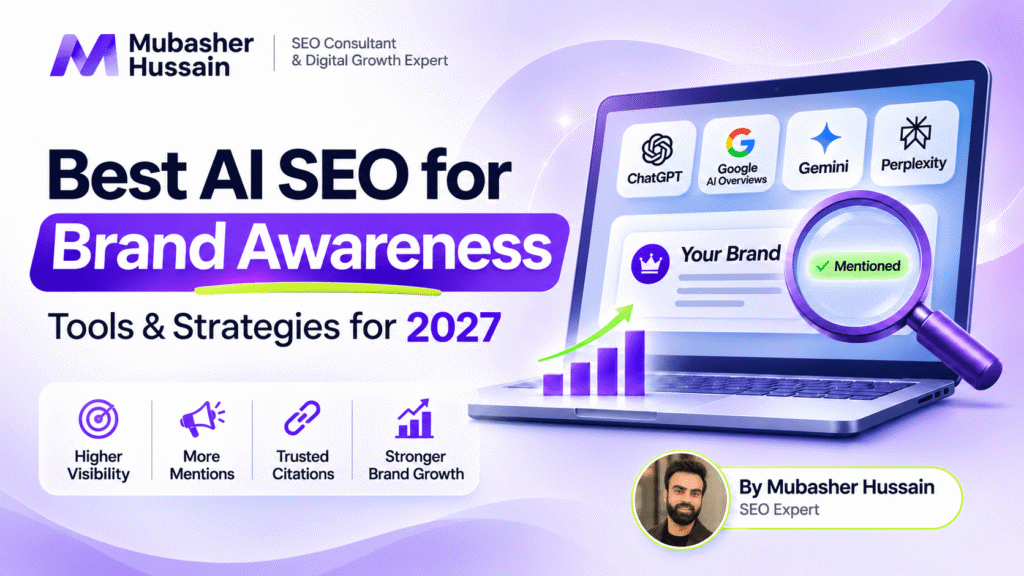

Imagine someone asking ChatGPT, “What are the best SEO agencies for small businesses?”
The AI assistant recommends five companies. Your competitor appears in the answer, but your brand is nowhere to be found.
Your website might rank well on Google. You might have published hundreds of articles and invested in backlinks. Yet potential customers researching businesses through AI assistants may never encounter your name.
This is why AI SEO for brand awareness is becoming an important part of digital marketing.
Businesses no longer need visibility only in traditional search results. They also need to understand how their brands appear in AI-generated answers, recommendations, and comparisons.
But what is the best AI SEO strategy for brand awareness, and which tools should businesses use?
Let’s break it down.
What Is AI SEO for Brand Awareness?
AI SEO refers to strategies that help businesses improve their discoverability across traditional search engines and AI-powered search experiences.
For brand awareness, the objective is straightforward: increase the likelihood that people discover and recognize your brand when searching for relevant products, services, or information.
This includes visibility across platforms such as:
- Google Search and AI Overviews
- ChatGPT
- Google Gemini
- Perplexity
- Microsoft Copilot
- Other AI-assisted discovery experiences
For example, someone might ask an AI assistant:
“Which companies provide reliable white-label SEO services?”
If your agency is mentioned in the answer, that represents a brand exposure opportunity, even when the person does not immediately visit your website.
However, a brand mention, a website citation, and a recommendation are different outcomes. Businesses should measure them separately rather than assuming every mention leads to customer interest.
What Is the Best AI SEO Strategy for Brand Awareness?
There is no single technique that guarantees brand visibility across AI platforms.
In my view, the strongest approach combines five areas:
- Traditional SEO: Build a technically accessible, useful website that performs well in relevant searches.
- Answer Engine Optimization (AEO): Make important information easy to find and understand.
- Generative Engine Optimization (GEO): Improve the quality, credibility, and discoverability of information that generative search systems may reference.
- Brand authority: Develop genuine recognition through industry coverage, relevant mentions, customer experiences, and expert contributions.
- AI visibility monitoring: Track where your brand is mentioned, which competitors appear, and which sources AI systems cite.
These activities work best together.
A business with excellent website content but very little independent recognition may struggle to differentiate itself.
Similarly, a well-known brand with a technically inaccessible website may miss opportunities to appear as a useful cited source.
The goal is to build a consistent digital presence rather than optimize for one AI platform alone.
Businesses exploring this approach can begin with AI search optimization services.
Best AI SEO Tools for Brand Awareness in 2027
Several tools now help businesses monitor their appearance in AI-generated answers.
These platforms have different strengths. Some focus on prompt monitoring, others emphasize competitive intelligence, citations, or broader SEO integration.
1. Ahrefs Brand Radar
Best for: SEO teams that want AI visibility and competitor research together.
Ahrefs Brand Radar helps marketers investigate brand appearances across supported AI search experiences.
Its value comes from connecting AI visibility research with broader SEO and competitor intelligence.
Businesses can use it to investigate questions such as:
- Which competitors appear more frequently than our brand?
- Which topics are associated with our competitors?
- Where do AI search results mention our products or services?
- Which opportunities deserve further investigation?
For agencies already using Ahrefs, Brand Radar is worth evaluating before purchasing a separate monitoring platform.
Official website: Ahrefs
2. Semrush AI Visibility Toolkit
Best for: Businesses and agencies already using Semrush.
Semrush offers AI visibility capabilities designed to help marketers understand how brands appear in supported AI search environments.
These insights can complement traditional keyword rankings, organic search performance, and competitor analysis.
For example, an SEO agency could monitor whether its brand appears for relevant service-related questions and compare that visibility with competing agencies.
Its biggest advantage is the opportunity to analyze AI search alongside established SEO workflows.
Official website: Semrush
3. Profound
Best for: Enterprise brands and larger marketing teams.
Profound focuses on AI search intelligence and brand visibility.
It is worth considering for organizations that need more extensive monitoring, research, and reporting across AI search experiences.
Larger brands may want to understand how AI systems describe their companies, which information sources influence responses, and where competitors gain exposure.
Profound is especially relevant when AI visibility becomes an ongoing responsibility shared across SEO, content, communications, and brand teams.
Official website: Profound
4. Peec AI
Best for: Dedicated AI search visibility monitoring.
Peec AI is designed to help businesses analyze their presence across supported AI answer platforms.
It can be useful for understanding brand mentions, cited sources, and competitor visibility for selected search prompts.
For example, a marketing agency might monitor questions such as:
“Which SEO agencies specialize in dental practices?”
By reviewing answers over time, the agency can identify patterns and potential opportunities.
Official website: Peec AI
5. Otterly.AI
Best for: Small businesses beginning AI visibility monitoring.
Otterly.AI offers a relatively accessible entry point for tracking how brands appear in AI search results.
It can help smaller teams establish a baseline before investing in more extensive platforms.
For a business beginning its AI SEO journey, a focused list of relevant customer questions may be more useful than monitoring hundreds of generic prompts.
Official website: Otterly.AI
Which AI SEO Tool Should You Choose?
The right choice depends on your business size, current software, and reporting requirements.
| Tool | Best suited for |
|---|---|
| Ahrefs Brand Radar | Competitive AI visibility research |
| Semrush | Combining AI visibility with SEO workflows |
| Profound | Enterprise AI search intelligence |
| Peec AI | Dedicated prompt and citation monitoring |
| Otterly.AI | Smaller businesses starting AI tracking |
My recommendation: If you already use Ahrefs or Semrush, evaluate their AI visibility features first. For dedicated prompt monitoring, compare Peec AI and Otterly.AI. Larger organizations should also evaluate Profound.
No tool should be judged solely by the number of brand mentions it reports. Check its supported platforms, geographic coverage, prompt methodology, historical data, and reporting limitations.
How to Improve Brand Awareness Through AI SEO
Purchasing an AI visibility tool is not the same as improving your brand’s presence.
Monitoring helps identify problems. Your SEO and brand-building activities help address them.
Here are the strategies I would prioritize.
1. Make Your Brand Easy to Understand
AI systems need reliable information about who you are and what your company does.
Your website should clearly communicate:
- Your business name
- Services and products
- Target audience
- Service locations
- Areas of expertise
- Relevant experience and credentials
- Contact and business information
For example, a company that specializes in dental SEO should explain that specialization clearly instead of relying entirely on generic digital marketing descriptions.
Consistent business descriptions across relevant platforms can also help reduce confusion.
2. Publish Content That Answers Real Customer Questions
People often interact with AI assistants conversationally.
Instead of searching only for “SEO agency,” someone might ask:
“What should I look for when hiring an SEO agency for a local business?”
This creates opportunities for useful educational content.
Businesses should identify genuine customer questions and answer them with clear, experience-based information.
Avoid publishing dozens of repetitive AI-generated articles. Focus on content that adds something valuable.
Google’s guidance on AI-generated content emphasizes quality and warns against scaled content created without meaningful value.
3. Build Brand Authority Beyond Your Website
One of the biggest mistakes in AI SEO is concentrating exclusively on website optimization.
Independent brand recognition matters too.
Consider building your presence through relevant industry publications, expert contributions, professional communities, podcasts, case studies, and partnerships.
For example, an SEO consultant who regularly shares useful insights on reputable marketing websites may gain valuable exposure beyond their own domain.
This does not mean purchasing artificial mentions or distributing promotional content everywhere.
The objective is genuine recognition from relevant sources.
4. Strengthen Your Technical SEO Foundation
Technical SEO remains essential.
Make sure important pages are crawlable, indexable, internally connected, and accessible to relevant search systems.
Priorities include:
- Clear website architecture
- Descriptive page titles
- Relevant internal linking
- Appropriate structured data
- Accessible page content
- Correct robots directives
- Mobile-friendly layouts
- Updated XML sitemaps
Google’s guidance for AI features explains how website owners can approach their content’s inclusion in AI-powered Search experiences.
It is also worth reviewing Google Search Console’s generative AI reporting and associated controls.
A comprehensive technical SEO audit can help identify problems affecting website discovery.
5. Combine Local SEO With Brand Awareness
For service businesses, local credibility is especially important.
A customer might ask:
“Who is a reliable HVAC contractor in Los Angeles?”
The business needs more than optimized website copy. It should also maintain accurate local business information, credible reviews, useful location pages, and a trustworthy reputation.
Local SEO remains a valuable foundation for businesses that depend on geographically relevant customers.
Local ranking factors and AI recommendation systems are not identical, but high-quality local business information supports overall discoverability.
How Do You Measure AI SEO Brand Awareness?
Traditional SEO reporting focuses on rankings, impressions, traffic, and conversions.
AI brand awareness introduces additional measurements.
| Metric | What it tells you |
|---|---|
| Brand mention frequency | How often your brand appears in monitored AI answers |
| AI share of voice | Your visibility compared with competitors within a defined prompt set |
| Citation frequency | How often your website is referenced as a source |
| Branded search demand | Whether more people are searching for your company |
| AI referral traffic | Visits that can be attributed to AI platforms |
| Leads and conversions | Whether visibility contributes to business outcomes |
These measurements need context.
AI-generated answers can change depending on the prompt, location, personalization, and time. A monitoring tool’s results are samples, not a complete record of everything users see.
For that reason, compare consistent groups of commercially relevant prompts over time.
Use analytics, conversion tracking, and customer feedback alongside AI visibility reports.
A Practical 30-Day AI Brand Awareness Plan
Businesses do not need to overhaul their entire marketing strategy immediately.
Start with a manageable process.
Week 1: Establish your baseline
Select 20 to 30 questions potential customers might ask AI assistants. Include service recommendations, comparisons, and common buying questions.
Record whether your brand and competitors appear.
Week 2: Improve your website
Review your homepage, service pages, About page, technical accessibility, and important internal links.
Fix unclear service descriptions and missing information.
Week 3: Strengthen credibility
Improve useful content, publish a genuine case study where possible, and identify relevant opportunities for expert contributions or industry coverage.
Week 4: Measure progress
Repeat your initial prompt checks using the same methodology.
Review brand mentions, citations, competitor appearances, and relevant website traffic.
Use the findings to prioritize the following month.
Remember that 30 days is enough to establish a baseline and implement improvements, not necessarily enough to demonstrate reliable increases in brand awareness.
Frequently Asked Questions
What is the best AI SEO tool for brand awareness?
There is no universal winner. Ahrefs Brand Radar and Semrush are useful options for established SEO workflows, while Peec AI and Otterly.AI are worth evaluating for dedicated monitoring. Profound is another option for enterprise requirements.
Can AI SEO help my business appear in ChatGPT?
AI SEO can help improve the quality, accessibility, and discoverability of your brand’s online information. However, no service or tool can guarantee that ChatGPT will mention or recommend your business.
Is AI SEO different from traditional SEO?
AI SEO extends traditional SEO by considering visibility in AI-generated answers and recommendations. Technical SEO, helpful content, authority, and user experience remain important foundations.
How long does AI SEO take to improve brand awareness?
There is no fixed timeline. Outcomes depend on existing recognition, competition, content quality, and platform behavior. Businesses should evaluate results over multiple reporting periods.
Is AI SEO worth investing in for small businesses?
It can be, particularly when potential customers use AI assistants to research products, services, and providers. However, businesses should first ensure their website and core SEO foundations are sound.
Final Thoughts: The Best AI SEO Strategy Is About Building a Recognizable Brand
AI search is changing how customers discover businesses, but the fundamental objective of marketing remains the same.
People need to find your business, understand what you offer, and trust you enough to consider becoming a customer.
AI visibility tools can show where your brand appears and where competitors may be gaining attention.
They cannot replace meaningful content, genuine expertise, technical quality, or a trustworthy reputation.
The best AI SEO strategy for brand awareness combines strong traditional SEO, credible brand-building, useful content, and consistent measurement.
That is the approach I recommend as businesses prepare for 2027.
Want to Improve Your Brand’s Visibility in AI Search?
I’m Mubasher Hussain, an SEO consultant with more than 10 years of experience helping businesses and agencies improve their search visibility.
I work with businesses that want stronger organic performance, local search visibility, technical SEO improvements, and strategies that account for AI-powered discovery.
If you want to understand where your brand currently stands and what improvements deserve priority, get in touch to discuss your SEO strategy.